Growing our Urban Forests: The Challenge and Opportunity to Drive Impact
Trees and urban greening projects are becoming increasingly essential tools for city planners and policymakers across the country. Budgets and commitments that used to be driven by aesthetics and real estate prices now recognize the importance and role of urban forests in adapting to a changing climate, combating the urban heat island effect, and supporting climate justice. This shift is evident in the unprecedented $1.5 billion of funding within the Inflation Reduction Act (IRA) dedicated to the Forest Service’s Urban and Community Forestry Program over the next nine years. But despite growing support and targeted funds, existing financing challenges will need to be overcome to leverage this funding and make up for decades of underinvestment. In this post, we highlight five key challenges – from nursery supply to financing to public engagement – and potential solutions we are working on to scale impactful urban forestry efforts.
Urban Forests Today
Urban forests take many forms, including public parks, schools, greenways, street trees, private yards, and community gardens. These forests are an integral part of creating sustainable and livable cities, through aesthetics and psychological benefits, ecosystem and habitat services, and increasingly for climate adaptation and resilience.
Despite our growing urban population – roughly 4 out of 5 people in the United States live in urban areas today – and the mounting evidence of the benefits of city forests in light of climate change, nationally our urban canopy levels are falling woefully short. (Note: canopy cover is just one measure of our urban forest goals. We also need to assess shade equity, carbon, habitat, stormwater, and hydrological benefits.)
Disproportionate Impact
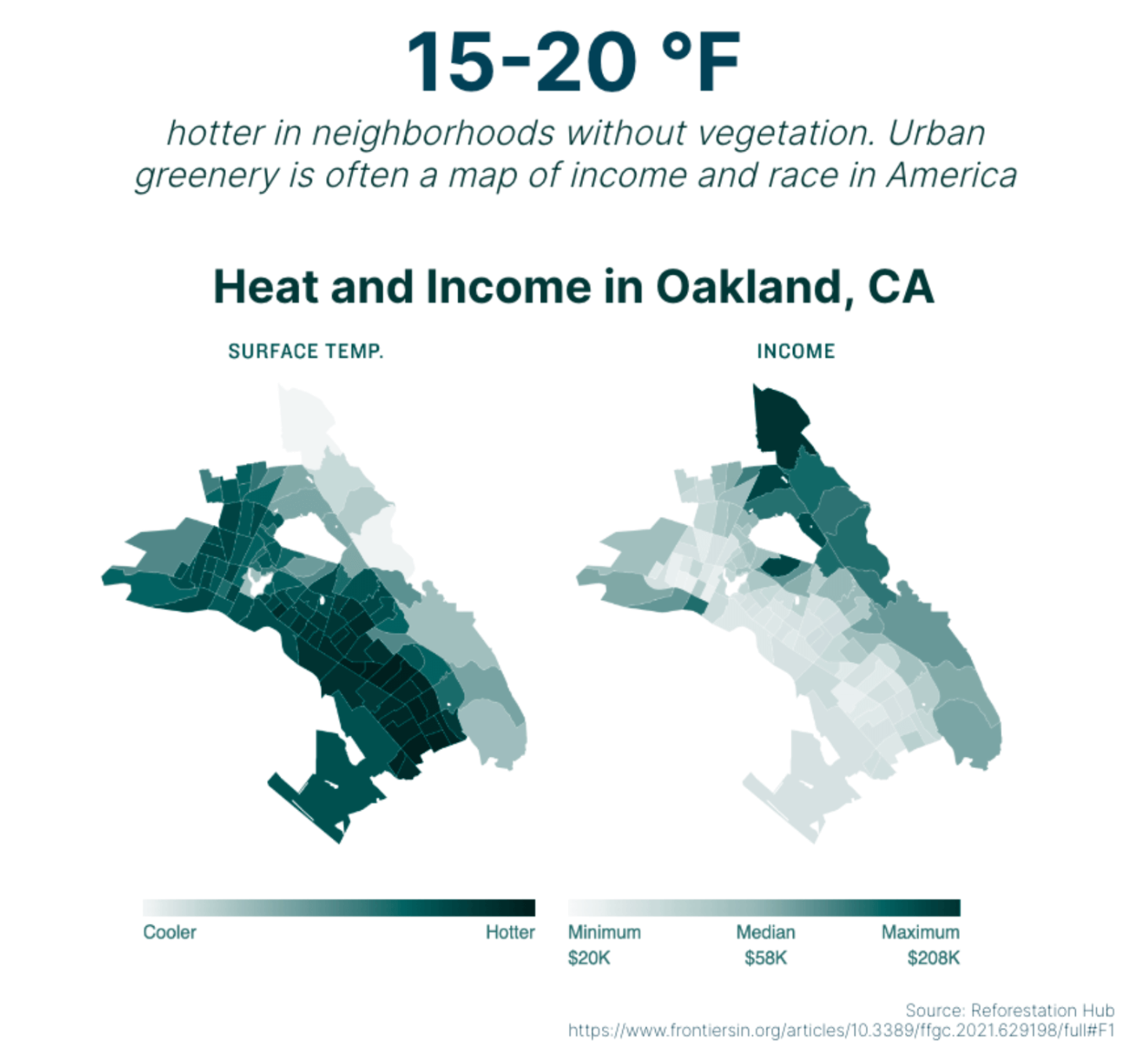
Urban greenery is not equally distributed across a country - or within cities.
Again and again, we see that low-income and minority neighborhoods have fewer trees than affluent neighborhoods, due to the lasting effects of red-lining, under-investment
In few places is this inequality as starkly visualized as in Oakland, CA - with massive disparity between income and urban tree planting.
Benefits of Growing Our Urban Forests
Increasing urban greenery and canopy coverage would bring extraordinary benefits. Each local context generates different combinations and scales of impact, but broadly speaking, expanding our urban forests will bring a combination of:
Environmental Benefits: Trees in urban forests improve air quality by filtering pollutants and capturing carbon dioxide. They also help regulate temperature, reducing the urban heat island effect and saving lives. Finally, trees help retain water in the soil, reducing the risk of flooding and improving groundwater quality, and serve as habitat for a variety of animal species.
Social Benefits: Urban forests provide recreational opportunities for residents and visitors, improving mental and physical health. Further, urban forests also serve as gathering places for communities, strengthening social bonds.
Economic Benefits: Urban forests increase property values, reduce energy costs by providing shade and insulation, and infrastructure costs by reducing stormwater runoff. They can also provide a local source of food through urban agriculture and increase tourism.
In assessing combined benefits, US Forest Service calculated that forevery $1 spent on planting or maintaining a street tree generates $5.82 in benefits across carbon, air, energy, rainfall, and property values.
Key Challenges
Despite these benefits and funding assistance on the way through the federal programs like the Inflation Reduction Act, there are still significant challenges to scaling urban forests. We see five key barriers:
-
One of the key hurdles is the shortage of tree nursery capacity, which is part of the broader challenge of ensuring an ample supply of plants and seedlings for urban forest projects. Quantity is not the sole consideration; factors such as quality, cost, and logistics also come into play. For instance, nurseries may not always have suitable species or cultivars for specific locations or climates, which can hinder the success of tree-planting efforts. Moreover, issues like poor root systems or susceptibility to diseases can compromise the quality of the plants.
-
The disconnect between buyers and sellers leads to certain seedlings being composted rather than planted. Further, logistical challenges can arise, particularly in urban areas where transportation and delivery can be arduous or costly.
-
There is limited space available for trees and vegetation in densely populated areas, posing difficulties in the establishment and maintenance of urban forests.
-
Funding for urban forests is often constrained, particularly in regions with critical competing budget priorities. The ongoing maintenance and management of urban forests, including tasks like pruning, watering, and pest control, present additional challenges - needing multi-year commitments, often across political cycles. Cities may struggle to allocate adequate resources and staffing for these essential activities.
-
Urban forestry is relegated to the sidelines due to a political tendency to prioritize short-term goals over long-term benefits that takes advantage of a lack of public awareness and understanding regarding the significance of urban forests. This contributes to difficulties in securing community buy-in for such projects, compounding implementation frustrations.
Solutions
To tap into the abundant benefits and overcome these challenges, strategies to bolster urban forests include:
-
Go Local
Increase investment in tree nurseries that localize supply in dedicated regions. Localizing supply ensures that urban forests are planted with trees suited to the local climate and soil conditions, leading to healthier and more resilient tree populations.
Climate-Smart Products
Choose tree species that are adapted to the urban environment and can withstand the stresses of city life - and for how those conditions are forecasted to change over time.
Research and Development
Hydroponic and aeroponic systems can help overcome space constraints and improve tree survival rates in densely-populated urban areas. New mycorrhizal inoculation and soil restoration techniques can enhance tree growth and health, especially in degraded urban soils.
-
2.1 Plant Exchange
Increase market transparency and functionality, allow for long term planning and improve ease and cost of transactions by aggregating regional demand and standardizing procurement in a centralized platform.
-
Long Term Planning
Cities incorporate green spaces into new urban developments and planning, including parks, green roofs, and street trees. Improved forecasting, communication, and monitoring of needs and impacts can help city planners and suppliers make more informed decisions.
-
Innovative Finance
Creating and tailoring investment instruments to finance urban reforestation can attract new funding sources and scale up the volume and longevity of planting projects.
Carbon Markets
Voluntary (and, in the future, regulated) carbon markets can accelerate urban forestry initiatives by unlocking new cashflows and from the issuance and sale of carbon credits generated from tree planting and maintenance projects - aligning with a wider range of investors, including purely commercial capital.
-
Community buy-in
Cities can engage with residents and local organizations to build support for urban forests. Moving from top-down charity to bottom-up education, outreach and financial empowerment can help raise awareness and encourage residents to participate in urban forest projects.
Our Approach
New Leaf uses innovative finance to unlock the environmental, social, and economic impact of urban forests. Against a background of growing global support, momentum and attention for green urban infrastructure, we aim to accelerate action across:
Supply and quality:alongside our work in rural markets, we are developing a fund to invest in new nursery capacity for cities. Financing will support both the local supply of trees and stimulate economic activity by creating jobs and ensuring long-term expertise and capacity to support urban green infrastructure.
Market Inefficiencies:By creating a marketplace platform that facilitates direct transactions between nurseries and urban forestry projects, and serving as a demand aggregator to strengthen regional demand signals, we can increase the supply of trees and lower costs for urban forestry projects.
Sustainable finance: innovative transaction structures provide incentives to restore, protect and expand urban forests and pathways to financial sustainability outside grant and budget cycles. Carbon and Payments for Ecosystem Services play a role here but are not the only tools - transaction-specific outcomes financing or pay-for-success models, endowments, crowdsourcing and new fiscal mechanisms all contribute to getting more capital that is better aligned into the system.
Urban forestry has numerous benefits, from mitigating the effects of climate change and improving air and water quality to enhancing mental and physical health and fostering community engagement. With historic commitments of public investment into our urban forests, we need to develop the underlying infrastructure and capacity to leverage these funds and create pathways for future funding. By supporting the production of trees and plants, stimulating economic activity, and promoting community engagement, we are committed to advancing urban forestry and creating green, livable cities for all.